MindTimbre™ shows your pitch, the harmonics in your voice and the musical ratios between them. Every number has its formula one tap away, and every pattern is tested against chance.
Coming to the App Store. iPhone, iOS 17 or later. Android to follow.
Why MindTimbre
Your voice has a shape. Most apps only show you a number.
A tuner tells you the note. A spectrum app shows you a jagged graph. Neither tells you what you're looking at, and some frequency apps attach health meanings to numbers that were never measured.
MindTimbre does the opposite. It shows the pitch, the harmonics and the musical ratios in your voice, labels what each peak is, and explains every calculation in plain language. When you look for patterns, it tells you honestly whether they stand out or would turn up by chance.
The result: you understand your voice, you can see it change over time, and you can trust what you see.
The shape of your voice
Same note, different voice. The shape is the difference.
When you sing or speak a note, your voice doesn't make one frequency. It makes the note plus a stack of harmonics above it, at two, three, four times the frequency and beyond. How strong each harmonic is gives your voice its colour, or timbre. Drawn as a graph, that's the shape of your voice.
Voice 1, A3 (220 Hz) Energy reaches high into the upper harmonics, so it sounds bright and ringing.Voice 2, A3 (220 Hz) Energy sits in the lowest harmonics, so it sounds warm and soft.
Two illustrative voices on the same note. A tuner would show both as A3. MindTimbre shows the harmonics, numbered 1 to 10, that make them sound different.
Why look at the shape?
Hear what makes your voice yours
Pitch is only the starting point. The shape is why a friend knows it's you on the phone after one word, and why two singers on the same note never sound the same.
See what your ears miss
Small changes in vowel, resonance and placement move the peaks before you can easily hear the difference. Sing “ee” then “oo” on one note and watch the shape change.
Track progress you can see
Save voice prints weeks apart and compare them on one chart, harmonic by harmonic, instead of relying on your memory of how you used to sound.
Compare before and after
Record before and after a warm-up, a lesson, a practice session or a tone session, and see exactly what changed and what didn't.
Talk about sound in specifics
“The third harmonic is stronger” is easier to work with than “it sounded brighter”. Share prints with your teacher or practitioner and point to the same thing.
Understand how sound works
Harmonics, overtones and whole-number ratios stop being theory when you can see them in your own voice and play them back.
What the shape doesn't tell you
The shape describes sound, nothing more. It isn't a reading of your health, mood or body, and MindTimbre never treats it as one.
Five tools in one app
Use your voice, explore, test, play and look back.
Voice
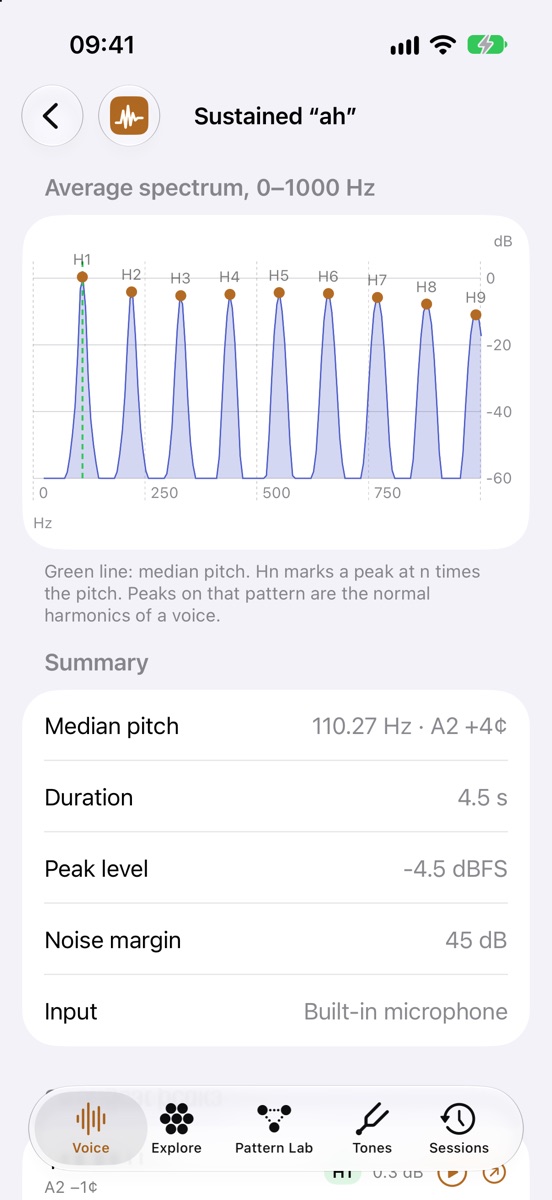
Live: your note and how many cents sharp or flat, a pitch trace and a live spectrum, then a session summary where you rate how it went. Voice prints: guided takes (a held "ah", a hum, a glide or counting) with the average spectrum, median pitch and strongest peaks, each labelled as a harmonic where it is one.
Explore
Any frequency as a note, its intervals in just or equal temperament, every octave equivalent, the 16-step overtone series and a full ratio table you can play. Try the Lambdoma matrix.
Pattern Lab
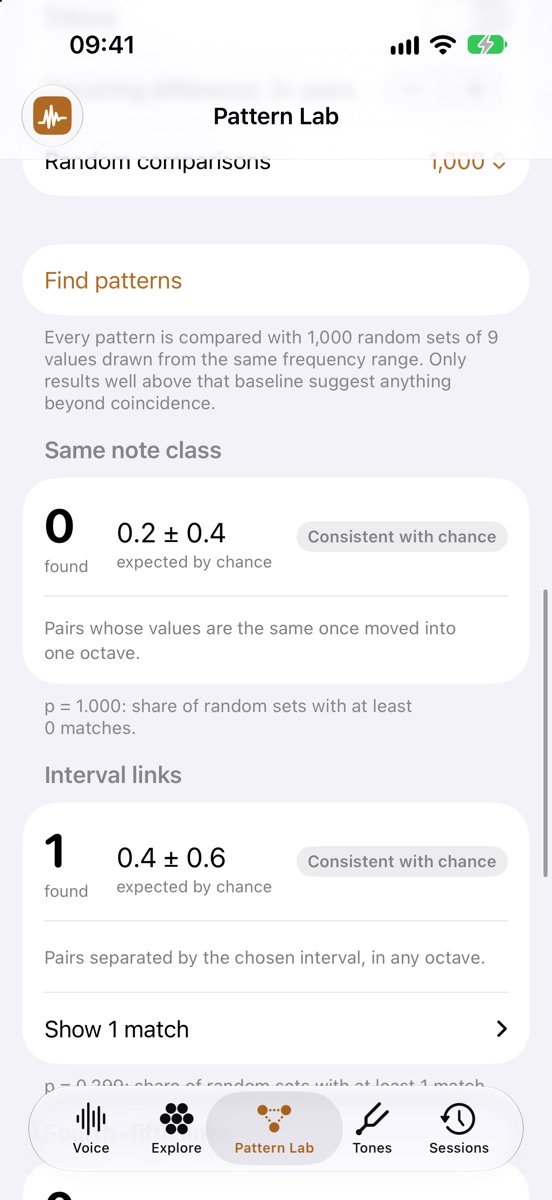
Look for repeated notes, intervals and shared differences in a set of frequencies, then see how often the same patterns turn up in random sets.
Tones
Single tones, fifths, fourths, triads, overtone runs and binaural pairs, with a fixed output ceiling and gentle fades to protect your hearing.
Sessions
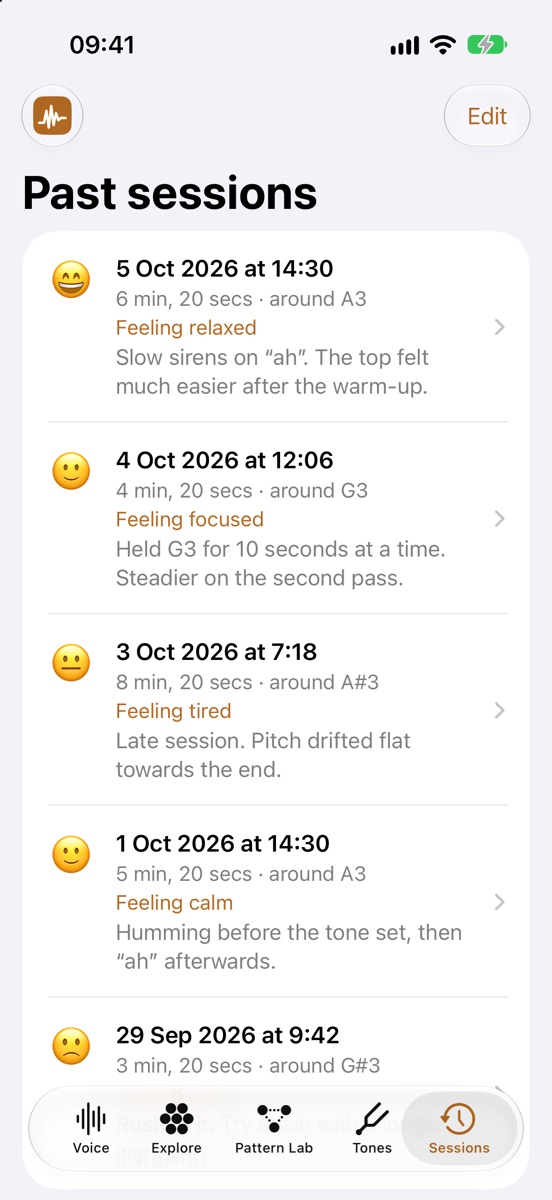
Every live session with its summary, your smiley rating, how you felt and your notes, so you can look back and see what helped.
Your data stays yours
Analysis happens on the phone, with no account needed. Share a voice print as a picture whenever you like. Cloud backup and practitioner sharing arrive in 2027, and will always be optional.
Inside the app
From hello to your history.
Real screens from MindTimbre on iPhone.
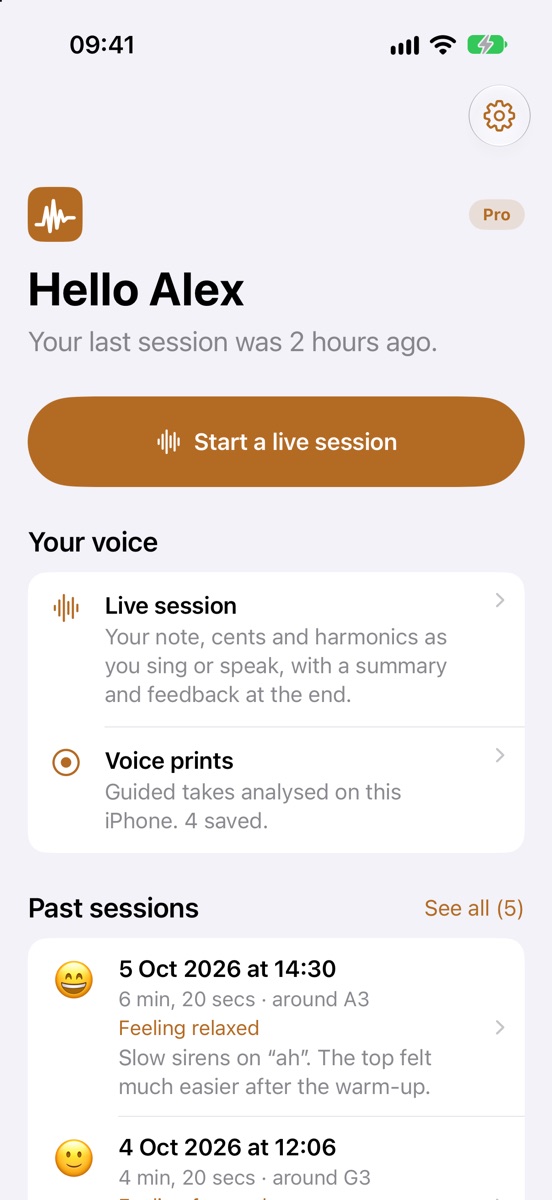
Dashboard Your greeting, a one-tap live session and your latest results.
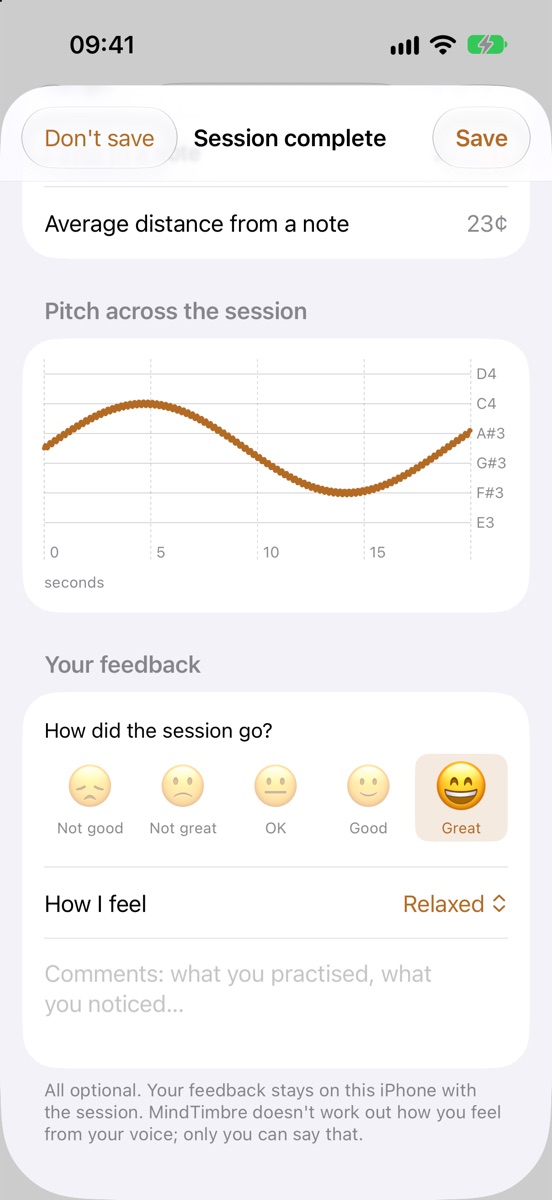
Session summary See your pitch across the session, then rate it and note how you feel.
Sessions Every session with your rating, feelings and notes, so you can see what helps.
Pattern Lab Every pattern measured against random sets, with an honest verdict.
Who it's for
Built for people who work with sound.
Singers and voice students
Hold a note in tune, see your range and resonance, and compare today's voice print with last month's. Practice with real feedback instead of guesswork.
Voice teachers and coaches
Show a student what changed, not just tell them. Before-and-after voice prints, harmonic labels and exportable data make lessons concrete.
Sound practitioners
Build tone sets from exact ratios, play intervals and binaural pairs safely, and record each client's voice print. From March 2027, Practitioner adds a portal for client sessions, and later monitoring a client's session live from wherever you are. See what Practitioner includes →
Researchers and brainwave headset users
Every formula is published and every result is reproducible. Tone timings are logged to the second, ready to line up with brainwaves from Muse, BrainBit or Vilistus.
Pattern Lab
Every pattern is compared with chance.
With enough frequencies and a loose enough tolerance, matches always appear. Pattern Lab counts the matches in your set, then runs the same search on up to 5,000 random sets from the same range, so you can see whether a result stands out.
The table shows a run on nine published example frequencies at a ±10 cent tolerance.
Pattern
Found
Chance
Result
Same note class
1
0.6 ± 0.8
Chance
Interval links (4th, 5th)
4
1.2 ± 1.1
Above chance
Fourth–fifth links
0
1.2 ± 1.0
Chance
Recurring differences
1
1.8 ± 1.2
Chance
1,000 random comparisons, fixed seed, so the same input always gives the same result. Interval links come out slightly above chance because voice peaks are harmonics, and harmonics naturally sit a fifth or fourth apart.
How it works
A voice session in four steps.
1
Make a voice print
Hold an "ah" for 15 seconds. MindTimbre finds your pitch and the strongest peaks, and labels the harmonics.
2
Explore
Tap any peak to see its note, intervals, octave equivalents and ratio table, and hear each one.
3
Test
Send the peaks to Pattern Lab to see which relationships stand out from chance and which don't.
4
Play and compare
Play a tone set or binaural pair, then record again and compare the two voice prints on one chart, with every harmonic's change listed.
MindTimbre
Voice print, tones, intervals and binaural pairs on iPhone.
⇄
Your brainwave headset
Brainwaves from Muse, BrainBit, Vilistus and more, recorded while your tones play.
With brainwaves
Tones on the phone, brainwaves from the headset.
Play a MindTimbre tone set while your brainwave headset records, then compare voice prints from before and after the session. From 2027, MindTimbre Cloud will put the tones and your brainwaves on one timeline.
Tap ⓘ on any section to see the formula behind it. The full engine specification is available on request.
No health readings
MindTimbre never links a frequency to a nutrient, organ, emotion or condition. It is not a medical device.
Results you can repeat
Each analysis stores the engine version and settings, so you can reproduce it exactly.
Private by default
Your recordings stay on the phone unless you export them or turn on cloud sync.
How MindTimbre is different
Straight answers about your voice.
Typical frequency apps
MindTimbre
How numbers are worked out
Hidden
Every formula one tap away
What a peak means
Left for you to guess
Labelled as a harmonic where it is one
Patterns in frequencies
Presented as findings
Compared with up to 5,000 random sets
Health claims
Often implied
None. It measures sound.
Your recordings
Often uploaded
Stay on your iPhone unless you choose
Works with brainwave headsets
Rarely
Muse, BrainBit, Vilistus (coming soon)
Who we are
Made by the team behind Vilistus and Mindstreams.
MindTimbre is built by Durham Systems Management in the English Lake District. We've spent years building software that reads signals from the body, and we built MindTimbre the same way: measurements first, every formula published.
Stephen ClarkFounder and Managing DirectorDavid ClarkHead of Software Engineering
Join the launch list and get 40% off your first year: Pro for £17.99 or Practitioner for £59. Start free, with a 14-day trial of Pro at launch. Practitioner opens with the portal in March 2027.
Free plan forever: live pitch, Explore and single tones
No account needed to start, and no data leaves your phone